Australasian Agribusiness Review - Vol.14 - 2006
Paper 10
ISSN 1442-6951
----------------------------------------------------------------------------
Evolving Trends of Grain Production in China[1]
Zhang-Yue Zhou and Wei-Ming Tian
Zhang-Yue Zhou, School of Business, James Cook University, Townsville QLD 4811, Australia
E-mail: zhangyue.zhou@jcu.edu.au
Wei-Ming Tian, College of Economics and Management, China Agricultural University, Beijing, 100094, P.R.China
E-mail: tianwm@vip.sina.com
Abstract
Grain is China’s most significant agricultural product, its output being the most watched indicator by government officials, traders and researchers inside and outside China. This paper looks into China’s grain production trends in the recent decade, both before and after China’s WTO accession. It examines changes in total grain output, grain crop composition, regional distribution of grain production, and also changes in production technologies and costs. The paper concludes by addressing a number of emerging issues that are likely to affect future grain production in China.
Key words: China, grain production, structural adjustment, farm support, foodgrain vs feedgrain
Introduction
The level of China’s grain output is a most important indicator to government officials, traders and researchers both inside and outside China. This indicator is important for several reasons. First, the level of the grain output has a significant bearing on China’s domestic demand-supply situations and subsequently the price level of grains. Too high a level of the grain price is always a concern to the government due to social and economic stability considerations. Second, achieving national grain security has always been a priority for the government. Low level domestic production often leads the government to adopting abrupt policies that have significant affects on grain production, and domestic and international grain trade. Third, when China imports or exports grains resulting from poor or bumper harvests, it tends to produce a major impact on the world grain prices, as has been frequently proven in the past two decades. Finally, China’s grain output level and future production trends are of significant importance to government officials and traders, for policy prescription and trade strategy formation.
In recent years, China’s grain production has fluctuated, and some major changes have been taking place in the grains industry. One issue that is of particular interest is how China’s grain production has responded to China’s accession to the WTO. Have any substantial adjustments taken place in China’s grains industry after the WTO accession? If so, what are they? How will such changes affect China’s future grain production prospects? In this paper an attempt is made to answer some of these important questions and provide a comprehensive overview of the developments in China’s grains industry in recent years.
To understand China’s grain production and its evolving trends, it is useful to appreciate the characteristics of China’s grain production; this is the subject of the next section. In Section Two, we examine changes in total grain output and in grain crop composition. In Section Three the dynamics in regional distribution of grain production are highlighted. Changes in production technologies and costs are presented in Section Four. In Section Five, we address a number of emerging issues that are likely to affect China’s future grain production. The last section is a conclusion.
1. Characteristics of China’s Grain Production
China’s grain production has some unique features. Such features affect not only short-run land and labour productivities, but also long-term prospects of the grain sector’s development and grain supply potential. Some major features of China’s grain production are highlighted below.
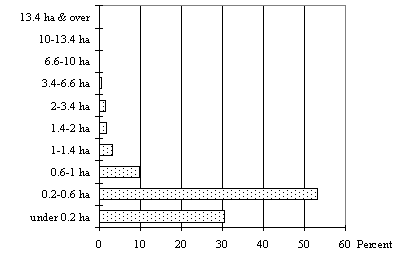
The most striking feature of China’s grain production is the very small scale of the operators who grow grain. China is the largest grain producer, producing 484 million tonnes in 2005 (the highest being 512 million tonnes in 1998) (SSBa 2006, p. 126). This huge amount of grains is produced by millions of small household farms. Following the rural economic reforms in the early 1980s, rural households again became the basic units of agricultural production. Land was distributed among farmers largely according to the number of people in a household. This resulted in a very small land area per household. Also the area may be composed of several small blocks due to the need to distribute land of varying quality to all farmers in an equitable manner. Farmers use these small blocks to produce a wide range of farm produce. In 2004, there were about 249.7 million household farms (SSBb 2005, p. 443). Land area cultivated by each farm is extremely small (Figure 1). Over 90 per cent of household farms work on an area that is less than 1 hectare while those that have a land area over 3.4 hectares account for less than 1 per cent. Yet most of China’s grain output in the vicinity of 500 million tonnes is produced by these small farms.
Figure 1. Scale distribution of cultivated land of farm households
Source: Office for National Agricultural Census (1998, p. 43).
Most of China’s grain is produced for on-farm consumption. According to the State Statistical Bureau (SSBb 2005, p. 474), each agricultural labourer produced on average about 1520 kg of grains, of which less than half was sold either to the state or on the market with the rest being retained for on-farm consumption. China’s grain production is still largely semi-subsistence.
Producing grains of the desired quality is difficult. The small scale of production coupled with inadequate grain marketing facilities makes it very difficult to produce grains of the desired quality at the desired quantity for specific usages. First, the quality of grains varies from farm to farm. Second, grains of similar quality are often not handled separately, due mainly to the high operational costs to do so when delivery is in small quantity. It is noted, however, as a result of increased demand for higher quality of grains, both the government and the grains industry have in recent years paid much attention to increasing the output of higher quality grains. This has been done through the provision of subsidised improved seeds and the use of contract production.
There tends to be an over-utilisation of land resources. Due to limited land resources and high demand for grains, China has to make full use, and sometimes overuse, of its land resources in order to produce enough grains. Multiple cropping has been widely practised throughout China as a way to raise land productivity. Intensive land use often leads to soil degradation, pollution resulting from fertiliser and chemical use, and depletion of water resources.
Regional patterns are distinct. Being such a vast country, China has diverse agronomic conditions. In line with local conditions, Chinese farmers produce different crops in various ways, resulting in distinct regional patterns of grain production. For example, rice is produced chiefly in southern China and wheat in northern China (see Section 3 later in this paper for details of regional distribution of various grains). Farmers also adopt various cropping systems according to local conditions. For instance, rice-based double or even triple cropping is a common practice in the tropical and subtropical areas and multiple cropping of upland crops is widely used in the temperate zone.
Grain production is still strongly affected by government policies. Although the Chinese government has in the past decade tried to liberalise its grain economy, it still maintains a strong degree of control over grain production. According to Tian and Zhou (2005), the degree of control depends on China’s grain output and the amount of grains that is in the government’s hand. The government intervenes in grain production whenever it is deemed necessary. However, it is noted that, in recent years, more and more indirect measures have been increasingly used by the government to achieve policy targets. Examples of such indirect measures include increased investment in rural infrastructure and in agricultural R&D and extension, and increased subsidy to the adoption of improved seeds.
Given the above features of China’s grain production, it may be appreciated that how China’s grain production will evolve in the future is likely to be complicated and will be affected by various factors. Particularly in relation to government policy, any dramatic changes may overshadow predicted general trends of grain production as happened in the past two decades. Keeping this in mind, in the rest of this paper, we examine major trends in China’s grain production in recent years and identify important factors that will affect its longer term development.
2. Grain Production and Crop Composition
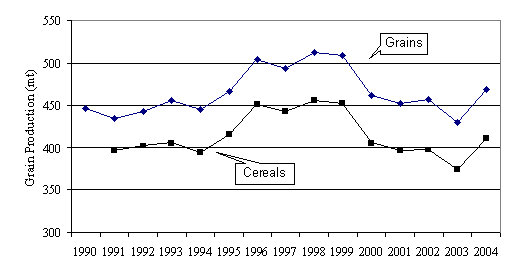
Since 1990, China’s total grain production has fluctuated. This fluctuation is closely related to structural changes that have taken place in China’s broader agricultural sector. Changes in the production of grains have typically exhibited a reversed ‘U’ shape (see Figure 2).
Figure 2. Trends in China’s total grain production
Source: SSBb (2005, p. 462)
The promotional policies and the high prices since 1994 stimulated grain production strongly. As a result, grain output rose notably in subsequent years until 1998 when China registered a record high of 512 million tonnes of grains. The strong growth in domestic supply, coupled with declining world grain prices, resulted in stockpiling of grains in government reserves, usually grains of low quality. In response, the government encouraged farmers to adjust their production according to market demand. Grain prices, including state procurement prices, have declined to varying extents since 1998 (MOA 2003). Consequently, China’s grain output dropped in 1999 by 4 million tonnes and during 2000-02 total grain output remained 50-60 million tonnes lower than the 1998 level. The consecutive lower grain output since 1999, further prompted by a rising price since September 2003, caused Chinese policymakers to deploy various measures in early 2004 in order to promote grain production (see Tian and Zhou 2005 for details).
Grain in China includes cereals (rice, wheat, corn, sorghum, millet and other miscellaneous grains), tuber crops (sweet potatoes and potatoes only, not including taro and cassava), as well as pulses (including mainly soybeans, red bean, and moonbean). The output of tuber crops (sweet potatoes and potatoes) was converted on a 4:1 ratio, i.e., four kilograms of fresh tubers were equivalent to one kilogram of grain, up to 1963. Since 1964, the ratio has been 5:1. The output of beans refers to dry beans without pods. Grain production level as presented in Figure 2 includes all these ‘grains’. Cereals, however, occupy an overwhelming importance in grain production, accounting for about 89 per cent of the total grain output. Since 1991, the government has issued separate statistics for cereals. In the future, cereals will receive ever-increasing attention in the discussion of grains.
In this section, we focus on the production changes in cereals. Table 1 indicates three major changes in cereal production since 1991: (1) decline in area sown to cereal crops, (2) fluctuation in cereal output, and (3) changes in the composition of cereal crops.
Table 1. Trends in cereal production
Year |
Sown area (million hectares) |
Output (million tonnes) |
|||||||
Total |
Rice |
Wheat |
Corn |
Total |
Rice |
Wheat |
Corn |
||
1991 |
94.07 |
32.59 |
30.95 |
21.57 |
395.7 |
183.8 |
96.0 |
98.8 |
|
1992 |
92.52 |
32.09 |
30.50 |
21.04 |
401.7 |
186.2 |
101.6 |
95.4 |
|
1993 |
88.91 |
30.36 |
30.24 |
20.69 |
405.2 |
177.5 |
106.4 |
102.7 |
|
1994 |
87.54 |
30.17 |
28.98 |
21.15 |
393.9 |
175.9 |
99.3 |
99.3 |
|
1995 |
89.31 |
30.74 |
28.86 |
22.78 |
416.1 |
185.2 |
102.2 |
112.0 |
|
1996 |
92.21 |
31.41 |
29.61 |
24.50 |
451.3 |
195.1 |
110.6 |
127.5 |
|
1997 |
91.96 |
31.77 |
30.06 |
23.78 |
443.5 |
200.7 |
123.3 |
104.3 |
|
1998 |
92.12 |
31.21 |
29.77 |
25.24 |
456.2 |
198.7 |
109.7 |
133.0 |
|
1999 |
91.62 |
31.28 |
28.86 |
25.90 |
453.0 |
198.5 |
113.9 |
128.1 |
|
2000 |
85.26 |
29.96 |
26.65 |
23.06 |
405.2 |
187.9 |
99.6 |
106.0 |
|
2001 |
82.60 |
28.81 |
24.66 |
24.28 |
396.5 |
177.6 |
93.9 |
114.1 |
|
2002 |
81.47 |
28.20 |
23.91 |
24.63 |
398.0 |
174.5 |
90.3 |
121.3 |
|
2003 |
76.81 |
26.51 |
22.00 |
24.07 |
374.3 |
160.7 |
86.5 |
115.8 |
|
2004 |
79.35 |
28.38 |
21.63 |
25.45 |
411.6 |
179.1 |
92.0 |
130.3 |
|
Source: SSBb (2005, pp. 458, 462).
In the late 1990s, the government was concerned by excessive stocks of cereals, which represented a heavy fiscal burden at both the national and regional levels. To reduce both the stock level and the downward pressure on the price in the grain market which had suppressed farmer income, the government took various measures to encourage farmers to adjust their crop production. One major measure was the ‘Grain for Green’ program. Under this program, farmers in areas where resources are not conducive for grain production are provided with incentives to restore their cultivated land to forests, pastures or lakes, in an effort to rehabilitate the degraded or damaged environment. By 2003, about 8 million hectares of cultivated land had been planted to trees (State Forestry Bureau 2004).
During 1999-2004, total area planted to cereals deceased from 91.6 million hectares to 79.4 million hectares, a reduction by 13.3 per cent. Apart from land set aside for conservation purposes under the ‘Grain for Green’ program, relatively low return from cereal crops, rapid urbanisation and increased use of arable land for non-agricultural purposes (e.g., highway construction) are major causes of the reduced areas sown to cereals.
There is a clear trend of devoting more land area to corn production at the expense mainly of wheat. In 2004, the share of corn area in total area planted to cereals rose to 32 per cent, compared with 23 per cent in 1991. Meanwhile, the share of rice remained at about 35 per cent, but the share of wheat declined from 33 per cent to 27 per cent. Apart from strong domestic demand for corn as feed, the increase in sown area to corn is induced by the relatively high price of corn in the domestic market, which is partially attributed to government policies in the late 1990s to subsidise corn export (Tian et al. 2005). The decline in wheat output is mainly due to reduction of spring wheat, which is of inferior quality. In 1990, the output of spring wheat was 13.3 million tonnes, but it declined to 4.3 million tonnes in 2003 (MOA 2004, p. 24). (The output in 2004 rose to 5.7 million tonnes as a result of the policies stimulating grain production.)
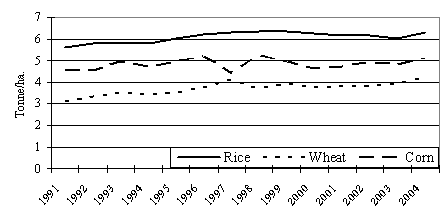
The fluctuation in cereal output largely matches that of total grain output. China’s cereal output increased sharply in 1996, then remained at a level around 450 million tonnes before the decline in 2000 (Table 1). The decline in cereal production in recent years is attributed to the reduction in planting areas as discussed above while yields remained relatively stable.
Figure 3. Changes in yields of major cereals
 |
Source: Calculations based on SSBb, various issues.
Figure 3 shows that although the yields of major cereal crops in recent years were higher than that in the early 1990s, they are slightly lower than the respective peak levels. Lower yields are partially due to a downward movement of grain prices during 1997-2002 that did not entice farmers to use more inputs. Apart from this, a shift towards producing cereal varieties of higher quality is another, perhaps more important, reason. The area planted to high quality varieties in 1998 was 2.27 million hectares for early indica rice, 1.60 million hectares for wheat, and 1.93 million hectares for corn. By 2004, the area planted to high quality varieties increased to 14 million hectares for all rice varieties (accounting for 54.6 per cent of total area sown to rice); 8.27 million hectares for wheat (38 per cent of total area sown to wheat), and 6.8 million hectares for corn (28 per cent of total area sown to corn) (MOA 2004, p. 13). In 2004, there was an increase in the yields of the three major cereals. Wheat yield reached an all-time high while the yields of rice and corn were very close to the record high in 1998. It seems that the farm support provided by the government to grain producers in 2004 has encouraged farmers to increase yields.
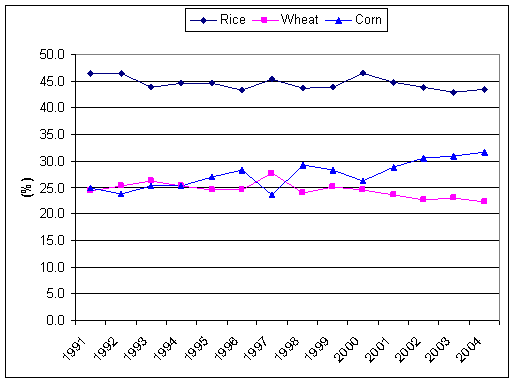
Although total cereal output has fluctuated over time, the proportion of each of the major cereals (wheat and corn and unmilled rice) in the total output has remained fairly stable (see Figure 4). However, the change in proportion does exhibit certain trends. That is, the share of rice in total cereal output tends to decline slightly over the years. The share of wheat remained at about 25 per cent till 2000 but seems to have experienced a notable decline since 2001. The share of corn generally shows an increasing trend, increasing at the expense of rice and wheat shares. At the aggregate level, the proportion of these three major cereals continues to dominate the total cereal output, accounting for 97 per cent in recent years compared to 95 per cent in the early 1990s.
Figure 4. Proportion of major cereals out of total cereal output
Source: Calculations based on data in SSBb (2005, p. 462).
The other 3-5 per cent of the cereal output is for minor cereal crops. Factors responsible for the decline in the share of minor cereal crops from 5 per cent to 3 per cent are: (1) only high quality minor cereals can sell at remunerative prices. However, such products are usually site-specific and cannot be planted widely. (2) Change in the alcohol industry also has an impact. The reduction of alcohol content of spirits and a shift from spirits to beer and wine has reduced the demand for minor cereals (such as sorghum and millet). (3) Large imports of higher quality barley for brewery purposes reduce the demand for domestically produced barley. Limited efforts have been devoted to improving domestic barley varieties and production techniques.
The changes in the composition of the three major cereals are chiefly induced by market forces. The key driving force is the reduced direct human consumption of grains and increased use of grains as animal feed. In urban areas, per capita grain consumption has declined sharply from 131 kg in 1990 to 78 kg in 2004 (SSBb 2005, p. 344). Per capita consumption of grains in rural areas has also declined (Zhou et al. 2005). Accompanying this reduced direct consumption of grains, consumer demand shifted to higher quality grains. Farmers have responded by producing more grains of higher quality. However, higher quality grains generally have lower yields, thus contributing to lower rice and wheat output and to lower shares of the total cereal output. On the other hand, increased demand for food of animal origin has boosted China’s demand for feedgrains in the past decade or so. This has encouraged farmers to produce more corn.
3. Regional Distribution of Grain Production
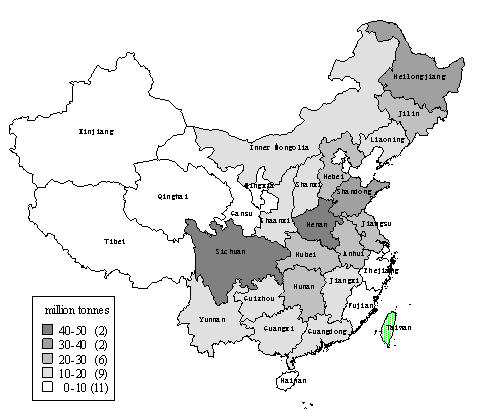
Map 1 shows regional distribution of grain production in China in 2004. In the past two decades, however, there have been changes in regional distribution of grain production. At the more aggregate level, grain production has shifted from the south to the north. In 1980, almost 60 per cent of China’s grains were produced by 14 provinces south of the Yangtze River (including Jiangsu, Anhui and Hubei, part of which are in north of the Yangtze River; in 1980, Chongqing and Hainan had not yet been separated from Sichuan and Guangdong). The 15 provinces north of the Yangtze River produced the other 40 per cent. However, by 2004, the proportion of grains produced by those provinces south of the Yangtze River had dropped by 9.5 percentage points, to being merely over 50 per cent while the proportion of grains produced by northern provinces had increased to 49.6 per cent. This has resulted in a change from ‘transporting grains from the south to the north’ (nan liang bei diao) to ‘transporting grains from the north to the south’ (bei liang nan yun).
Map 1: Regional distribution of grain production, China, 2004
Source: Based on SSBb (2005, p.462).
At the less aggregate level, the decline in grain production in southern China took place mainly in the wealthier south-east coastal region. From 1980 to 2004, this region registered a decline in the proportion of grain production out of the national total by 7.7 percentage points, while the four north-east provinces gained 6.3 percentage points (see Table 2, Panel A). The other major gaining region is the four provinces in north Central China, by 3.1 percentage points. Changes in the share in all other regions seem to be marginal. Hence, it can be concluded that grain production has been declining in China’s south-east coastal region but increasing in the north-east region. Table 2 also shows that Central China remains the major grain-producing region in China.
Table 2. Changes in regional distribution of grain production, 1980-2004 *
A. All Grain |
||||||
Region |
1980 |
1990 |
2000 |
2004 |
||
Beijing-Tianjin |
1.0 |
1.0 |
0.6 |
0.4 |
||
North-east |
12.3 |
15.3 |
14.2 |
18.6 |
||
South-east |
20.7 |
17.9 |
15.8 |
13.0 |
||
Central China |
40.9 |
42.9 |
44.2 |
43.6 |
||
Central China – North |
21.0 |
22.2 |
24.5 |
24.1 |
||
Central China – South |
19.8 |
20.7 |
19.6 |
19.5 |
||
South-west |
19.3 |
16.7 |
18.9 |
18.0 |
||
North-west |
5.8 |
6.1 |
6.3 |
6.4 |
||
North of Yangtze River |
40.1 |
44.6 |
45.7 |
49.6 |
||
South of Yangtze River |
59.9 |
55.4 |
54.3 |
50.4 |
||
Output (mt) |
320.6 |
446.2 |
462.2 |
469.5 |
||
B. Rice |
||||||
Region |
1980 |
1990 |
2000 |
2004 |
||
Beijing-Tianjin |
0.4 |
0.3 |
0.1 |
0.1 |
||
North-east |
3.0 |
5.3 |
9.9 |
11.3 |
||
South-east |
34.4 |
30.4 |
27.3 |
23.8 |
||
Central China |
37.8 |
40.4 |
37.8 |
40.0 |
||
Central China – North |
2.4 |
2.4 |
2.7 |
2.8 |
||
Central China – South |
35.3 |
38.0 |
35.1 |
37.2 |
||
South-west |
23.4 |
22.6 |
23.6 |
23.8 |
||
North-west |
1.0 |
1.1 |
1.2 |
1.0 |
||
North of Yangtze River |
6.9 |
9.0 |
13.9 |
15.2 |
||
South of Yangtze River |
93.1 |
91.0 |
86.1 |
84.8 |
||
Output (mt) |
139.9 |
189.3 |
187.9 |
179.1 |
||
C. Wheat |
||||||
Region |
1980 |
1990 |
2000 |
2004 |
||
Beijing-Tianjin |
1.2 |
1.7 |
1.3 |
0.6 |
||
North-east |
9.0 |
8.1 |
3.3 |
2.2 |
||
South-east |
12.9 |
11.1 |
8.9 |
7.8 |
||
Central China |
50.7 |
56.2 |
65.1 |
68.9 |
||
Central China – North |
39.1 |
45.8 |
55.4 |
58.2 |
||
Central China – South |
11.6 |
10.4 |
9.8 |
10.7 |
||
South-west |
11.9 |
8.9 |
9.3 |
7.8 |
||
North-west |
14.3 |
14.0 |
12.1 |
12.5 |
||
North of Yangtze River |
63.7 |
69.5 |
72.0 |
73.7 |
||
South of Yangtze River |
36.3 |
30.5 |
28.0 |
26.3 |
||
Output (mt) |
55.2 |
98.2 |
99.6 |
92.0 |
||
D. Corn |
||||||
Region |
1980 |
1990 |
2000 |
2004 |
||
Beijing-Tianjin |
2.3 |
2.1 |
0.9 |
0.9 |
||
North-east |
29.1 |
38.5 |
28.0 |
36.7 |
||
South-east |
2.6 |
2.7 |
3.3 |
2.4 |
||
Central China |
38.8 |
36.2 |
42.1 |
38.1 |
||
Central China – North |
36.5 |
33.1 |
36.7 |
33.3 |
||
Central China – South |
2.3 |
3.1 |
5.4 |
4.8 |
||
South-west |
19.1 |
13.3 |
16.5 |
13.2 |
||
North-west |
8.0 |
7.1 |
9.2 |
8.7 |
||
North of Yangtze River |
75.9 |
80.9 |
74.8 |
79.5 |
||
South of Yangtze River |
24.1 |
19.1 |
25.2 |
20.5 |
||
Output (mt) |
62.6 |
96.8 |
106.0 |
130.3 |
||
* The grouping of provinces into regions for this table is somewhat arbitrary. We carried out the grouping largely on the basis of local geographical conditions and the level of economic development. Beijing and Tianjin, two minor grain-producing areas, are placed into one group. The provinces included in each of the other groups are given below:
- North-east: Inner Mongolia, Liaoning, Jilin and Heilongjiang. Inner Mongolia is included in the north-east region because its grain production is concentrated in the east.
- South-east: Shanghai, Jiangsu, Zhejiang, Fujian, Guangdong and Hainan.
- Central China: Shandong, Shanxi, Henan, Hebei, Anhui, Jiangxi, Hunan and Hubei. These provinces are further divided into two sub-regions. The former four provinces are placed into the north Central China group and the latter the south Central China group.
- South-west: Guangxi, Chongqing, Sichuan, Guizhou, Yunnan and Tibet.
- North-west: Shaanxi, Gansu, Qinghai, Ningxia and Xinjiang.
Sources: SSBb, various issues.
Among other reasons, changes in the level of economic development between regions are primarily responsible for changes in regional distribution of grain production. Rapid economic development in the south-east coastal region made grain production a less attractive industry. Governments in such regions are keen to promote agricultural structural adjustments. After WTO accession, changes in regional distribution of grain production seem to have accelerated. China joined the WTO in 2001. Comparing 2004 with 2000, the share of grains produced by provinces south of the Yangtze River out of the national total reduced by almost 4 percentage points while it reduced by only 1.1 percentage points during 1990 and 2000. Clearly there was a major decline in grain production in the wealthier south-east region and the north-east region gained a major increase in grain production.
Changes have also occurred in regional distribution of grain production at the crop level. An overwhelming proportion of China’s rice (85 per cent) is still produced by those provinces south of the Yangtze River. Nonetheless, there has been an increasing trend in rice production in those provinces north of the Yangtze River, an increase by over 8 percentage points in 2004 compared to 1980 (see Table 2, Panel B). However, this increase has taken place mainly in the four north-east provinces (mainly in Heilongjiang) (by 8.3 percentage points). On the other hand, the proportion of rice production in those south-east coastal provinces has fallen by 10.6 percentage points. The proportional change in all other regions is relatively small. As mentioned earlier, the declining comparative advantage in grain production in the south-east region is largely responsible for the drop in the region’s rice production share. The north-east provinces are most suitable for the production of premium quality japonica rice, which has been in high demand by domestic consumers and also in demand for exports.
Wheat production has become increasingly concentrated in Central China, especially in the four provinces north of the Yangtze River (namely, Shandong, Shanxi, Henan and Hebei) (Table 2, Panel C). In 1980, about 51 per cent of China’s wheat was produced in the eight provinces in Central China. By 2004, this proportion has increased to 69 per cent, with 58 per cent being produced by the four northern provinces. Measurable changes have also occurred in the distribution of wheat production in most other regions. Compared to other regions, those north-east provinces experienced a larger reduction in wheat production (by 6.8 percentage points). Winter wheat cannot be produced in most parts of these provinces. While spring wheat production is possible, the quality is not good. In these provinces, wheat production has been to some extent substituted by rice and corn production.
Changes in the distribution of corn production in southern and northern China have been less drastic (see Table 2, Panel D). The proportion of corn produced in 2004 in provinces south of the Yangtze River was 3.6 percentage points lower than that of 1980. It is noted, however, there were some fluctuations in years in between. In south-east provinces, the proportion of corn production in the national total has been at around 3 per cent but reduced to 2.4 per cent in 2004. There was a small increase in this proportion, compared to 1980, by 2.5 percentage points in the four Central China provinces that are south of the Yangtze River. This is largely due to substitution of corn production for rice production, driven by the growing demand for feedgrain. Feedgrain has been in short supply in many southern provinces. Transporting corn from north-east China to south China is not only expensive but also places strain on the transportation capacity. The proportion of corn production in north-east China fluctuated quite significantly. Changing market prices and unfavourable weather conditions are largely responsible for the unstable corn production in these provinces. North-east China has become increasingly important in corn production. South-west China is a major corn-consuming area, due to pork production. Its corn production has, however, fluctuated and tended to decline. In the meantime, this region’s pork production out of the national total has also tended to decline.
An examination of changes in grain production at the provincial level further confirms that grain production patterns have been evolving largely in accordance with changed market demand and supply situations and local comparative advantages. Table 3 presents the share of grain output of each province out of the national total in three time periods of 1989-91, 1999-01 and 2002-04 (three-year average). They are so designed that we can indicate changes before the WTO accession (1989-91 – 1999-01) and after the WTO accession (1999-01 – 2002-04).
Table 3. Changes in distribution of cereal production
Rice |
Wheat |
Corn |
Cereal |
|||||||||
1989-91 |
1999-01 |
2002-04 |
1989-91 |
1999-01 |
2002-04 |
1989-91 |
1999-01 |
2002-04 |
1989-91 |
1999-01 |
2002-04 |
|
Beijing |
0.1 |
0.0 |
0.0 |
1.0 |
0.6 |
0.2 |
1.4 |
0.6 |
0.3 |
0.7 |
0.3 |
0.2 |
Tianjin |
0.2 |
0.1 |
0.1 |
0.6 |
0.6 |
0.4 |
0.8 |
0.5 |
0.6 |
0.4 |
0.3 |
0.3 |
Hebei |
0.5 |
0.4 |
0.3 |
9.5 |
11.7 |
11.8 |
8.8 |
9.0 |
8.9 |
4.8 |
5.7 |
5.7 |
Shanxi |
0.0 |
0.0 |
0.0 |
3.3 |
2.3 |
2.7 |
3.0 |
3.0 |
4.2 |
1.6 |
1.4 |
2.0 |
Inner Mongolia |
0.2 |
0.4 |
0.3 |
2.6 |
1.9 |
1.2 |
4.0 |
6.2 |
7.2 |
1.7 |
2.4 |
2.7 |
Liaoning |
1.9 |
2.0 |
2.3 |
0.4 |
0.4 |
0.1 |
7.6 |
6.8 |
7.7 |
2.9 |
2.9 |
3.5 |
Jilin |
1.4 |
2.0 |
2.2 |
0.1 |
0.1 |
0.1 |
14.4 |
11.5 |
13.5 |
4.3 |
4.3 |
5.3 |
Heilongjiang |
1.6 |
5.3 |
5.6 |
4.4 |
1.5 |
0.8 |
9.9 |
8.2 |
7.7 |
4.4 |
5.2 |
5.2 |
Shanghai |
1.0 |
0.7 |
0.5 |
0.3 |
0.2 |
0.1 |
0.1 |
0.0 |
0.0 |
0.6 |
0.4 |
0.3 |
Jiangsu |
9.2 |
9.6 |
9.3 |
9.0 |
8.4 |
7.2 |
2.6 |
2.2 |
1.8 |
7.5 |
7.2 |
6.4 |
Zhejiang |
7.3 |
5.3 |
4.1 |
0.8 |
0.5 |
0.2 |
0.1 |
0.2 |
0.2 |
3.8 |
2.6 |
2.0 |
Anhui |
6.5 |
6.6 |
7.0 |
5.1 |
7.5 |
7.9 |
1.6 |
2.0 |
2.6 |
4.9 |
5.5 |
5.8 |
Fujian |
4.1 |
3.5 |
3.2 |
0.3 |
0.1 |
0.0 |
0.0 |
0.1 |
0.1 |
2.1 |
1.7 |
1.5 |
Jiangxi |
8.4 |
8.2 |
8.5 |
0.1 |
0.1 |
0.0 |
0.0 |
0.1 |
0.0 |
4.2 |
3.8 |
3.8 |
Shandong |
0.4 |
0.6 |
0.5 |
17.7 |
18.3 |
17.5 |
13.4 |
13.1 |
11.5 |
8.1 |
8.6 |
8.0 |
Henan |
1.3 |
1.5 |
1.8 |
16.9 |
22.2 |
26.1 |
9.5 |
9.7 |
8.2 |
7.3 |
9.1 |
9.5 |
Hubei |
9.1 |
8.2 |
8.4 |
4.1 |
2.4 |
1.8 |
1.3 |
1.8 |
1.5 |
5.9 |
4.9 |
4.6 |
Hunan |
13.4 |
12.6 |
12.6 |
0.3 |
0.2 |
0.2 |
0.2 |
1.1 |
1.0 |
6.8 |
6.2 |
6.0 |
Guangdong |
8.8 |
7.7 |
6.8 |
0.2 |
0.0 |
0.0 |
0.1 |
0.6 |
0.4 |
4.5 |
3.7 |
3.2 |
Guangxi |
6.5 |
6.6 |
6.9 |
0.0 |
0.0 |
0.0 |
1.3 |
1.5 |
1.4 |
3.5 |
3.5 |
3.5 |
Hainan |
0.8 |
0.8 |
0.8 |
0.0 |
0.0 |
0.0 |
0.0 |
0.0 |
0.0 |
0.4 |
0.4 |
0.4 |
Sichuan * |
11.7 |
11.1 |
11.7 |
7.2 |
5.9 |
5.8 |
7.0 |
6.3 |
6.1 |
9.4 |
8.5 |
8.5 |
Guizhou |
2.0 |
2.5 |
2.5 |
0.7 |
1.0 |
0.9 |
2.1 |
2.9 |
2.7 |
1.7 |
2.2 |
2.2 |
Yunnan |
2.7 |
3.0 |
3.5 |
1.0 |
1.5 |
1.4 |
3.1 |
4.1 |
3.5 |
2.4 |
2.9 |
3.0 |
Tibet |
0.0 |
0.0 |
0.0 |
0.2 |
0.3 |
0.3 |
0.0 |
0.0 |
0.0 |
0.0 |
0.1 |
0.1 |
Shaanxi |
0.5 |
0.5 |
0.5 |
4.8 |
4.0 |
4.5 |
3.6 |
3.5 |
3.1 |
2.4 |
2.2 |
2.3 |
Gansu |
0.0 |
0.0 |
0.0 |
3.8 |
2.9 |
3.2 |
1.5 |
1.9 |
1.9 |
1.3 |
1.3 |
1.4 |
Qinghai |
0.0 |
0.0 |
0.0 |
0.8 |
0.5 |
0.4 |
0.0 |
0.0 |
0.0 |
0.2 |
0.1 |
0.1 |
Ningxia |
0.3 |
0.3 |
0.3 |
0.8 |
0.8 |
0.9 |
0.4 |
0.8 |
0.9 |
0.4 |
0.6 |
0.7 |
Xinjiang |
0.2 |
0.3 |
0.3 |
3.9 |
3.9 |
4.0 |
2.2 |
2.4 |
2.8 |
1.7 |
1.8 |
1.9 |
* Sichuan includes Chongqing.
Source: Calculations based on data from SSBb, various issues.
Currently, provinces having a large share in rice production are Hunan (12.6 per cent), followed by Sichuan (11.7 per cent), Jiangsu (9.3 per cent), Jiangxi (8.5 per cent) and Hubei (8.4 per cent). For wheat, the province having the largest share is Henan (26.1 per cent), followed by Shandong (17.5 per cent), Hebei (11.8 per cent), Anhui (7.9 per cent) and Jiangsu (7.2 per cent). Jilin had the largest share in corn production in 2002-04 (13.5 per cent), followed by Shandong (11.5 per cent), Hebei (8.9 per cent) Henan (8.2 per cent). Both Heilongjiang and Liaoning produced 7.7 per cent of China’s corn in 2002-02, while Inner Mongolia’s share was 7.2 per cent. In terms of total cereal production, Henan is the largest producer (9.5 per cent), followed by Sichuan (8.5 per cent), Shandong (8.0 per cent), Jiangsu (6.4 per cent) and Hunan (6.0 per cent).
According to Table 3, a general trend is emerging that production has become increasingly shifted to regions with greater comparative advantages. In terms of regional shares in the national output for rice, between 1989-91 and 2002-04, the largest increase occurred in Heilongjiang followed by Jilin and Yunnan, while the largest decline occurred in Zhejiang followed by Guangdong. As for wheat, the output share increased fastest in Henan, followed by Anhui and Hebei, while the share declined fastest in Heilongjiang, followed by Hubei, Jiangsu, and Sichuan. Changes in distribution of corn are somewhat complicated. Out of the three north-east provinces, while Inner Mongolia registered an increase in the output share, the share increased very marginally in Liaoning but declined in Jilin and Heilongjiang. On the other hand, the share of corn production in some southern provinces increased, led by Anhui, Hunan and Guizhou.
The above analysis clearly shows that changes in the regional pattern of grain production at both the crop level and all-cereal level have been taking place in the past 15 years or so. It is noted, however, structural changes in China’s grain production have taken place well before China’s WTO accession and indeed, data in Table 3 suggest that much of the change took place before the WTO accession, although such changes continued afterwards. This is not surprising. China applied to join the GATT (now the WTO) in July 1986 and met with many difficulties. Nonetheless, in the 1990s, the government intentionally pushed forward the market-oriented reforms of its economic systems in a gradual way to prepare China for entering the WTO (Tian and Zhou 2001). Various policy and market reforms were initiated by the government and more market forces were allowed to play a role in influencing production decisions. Such a policy and economic environment encouraged regional adjustments in grain production.
In the early 2000s, structural changes in grain production become easier. The government encouraged farmers to adjust their grain production in response to the WTO accession and to produce higher quality grains in order to solve the relative surplus problem. The extent to which farmers have made use of such opportunity varies from province to province (see Table 4), depending on their ability to use such an opportunity together with the comparative advantage their region possesses. Farmers in wealthier regions, such as in Beijing, Tianjin, Shanghai and Zhejiang, tend to have made greater adjustments to the level of their grain production and also to the composition of their grain crops, compared to their counterparts in less wealthy regions, such as Guangxi, Yunnan, Guizhou and Xinjiang. In economically developed regions, farmers have better access to non-agricultural activities and also to markets that allow them to alter their farm production. Farmers in poorer regions have limited such access. In some major agricultural provinces, land was deviated from cereal production to cash crops, such as vegetables and oilseeds. Table 4 also demonstrates to some extent that Chinese farmers are quite responsive to external changes. This suggests that if the government policies allow them to adjust their grain production and there is demand in the market for certain kinds of products, Chinese farmers will respond accordingly. How China’s future grain production patterns will evolve will be largely determined by market forces unless the Chinese government reverts to stricter administrative controls, which is less likely.[2]
Table 4. Proportional changes in cereal outputs and areas between 2004 and 2000
Region |
Output % |
Area % |
|||||||
Cereals |
Rice |
Wheat |
Corn |
Cereals |
Rice |
Wheat |
Corn |
||
Beijing |
-52.4 |
-94.7 |
-69.7 |
-25.9 |
-51.1 |
-94.2 |
-67.8 |
-31.1 |
|
Tianjin |
-1.3 |
-23.4 |
-36.4 |
66.6 |
-23.3 |
-61.3 |
-35.1 |
2.7 |
|
Hebei |
-1.5 |
-28.2 |
-12.8 |
16.4 |
-9.5 |
-42.0 |
-19.3 |
6.1 |
|
Shanxi |
33.1 |
-67.4 |
10.2 |
78.1 |
-4.7 |
-41.7 |
-27.4 |
41.8 |
|
Inner Mongolia |
24.5 |
-24.5 |
-39.2 |
50.7 |
-2.4 |
-31.7 |
-32.2 |
29.1 |
|
Liaoning |
57.4 |
6.5 |
-75.1 |
95.9 |
2.9 |
11.1 |
-82.5 |
12.4 |
|
Jilin |
57.8 |
16.8 |
-79.3 |
82.2 |
18.1 |
2.6 |
-85.3 |
32.0 |
|
Heilongjiang |
11.6 |
8.4 |
-13.4 |
18.8 |
-1.9 |
-1.1 |
-56.8 |
21.0 |
|
Shanghai |
-39.7 |
-34.8 |
-67.8 |
-30.8 |
-41.9 |
-36.5 |
-61.7 |
-19.8 |
|
Jiangsu |
-8.3 |
-7.1 |
-13.6 |
-8.5 |
-9.3 |
-4.1 |
-18.1 |
-8.0 |
|
Zhejiang |
-32.4 |
-30.6 |
-65.5 |
10.7 |
-38.6 |
-35.7 |
-66.5 |
4.4 |
|
Anhui |
13.5 |
5.8 |
11.7 |
46.5 |
0.7 |
-4.8 |
-3.1 |
36.3 |
|
Fujian |
-14.9 |
-13.8 |
-82.5 |
14.0 |
-21.5 |
-19.4 |
-84.0 |
2.6 |
|
Jiangxi |
5.1 |
5.9 |
-62.9 |
-43.5 |
5.0 |
7.0 |
-62.9 |
-43.2 |
|
Shandong |
-7.9 |
-18.3 |
-14.8 |
2.2 |
-13.0 |
-29.6 |
-20.8 |
1.7 |
|
Henan |
7.3 |
12.4 |
11.0 |
-2.3 |
2.1 |
10.6 |
-1.3 |
9.9 |
|
Hubei |
-4.6 |
0.3 |
-24.6 |
-17.3 |
-9.8 |
-0.3 |
-28.7 |
-15.7 |
|
Hunan |
-4.5 |
-4.5 |
-37.5 |
1.2 |
-5.2 |
-4.6 |
-35.8 |
-0.7 |
|
Guangdong |
-21.5 |
-21.1 |
-56.2 |
-26.3 |
-14.9 |
-13.3 |
-56.2 |
-27.2 |
|
Guangxi |
-8.0 |
-8.4 |
-29.6 |
-4.4 |
0.4 |
2.4 |
-40.0 |
-3.9 |
|
Hainan |
-3.1 |
-2.0 |
-10.5 |
-10.8 |
-8.9 |
-23.7 |
|||
Chongqing |
-1.8 |
-4.4 |
-22.6 |
15.3 |
-12.7 |
-3.5 |
-39.8 |
-8.0 |
|
Sichuan |
-9.5 |
-7.0 |
-21.9 |
1.8 |
-9.1 |
-2.8 |
-21.8 |
-5.1 |
|
Guizhou |
-3.9 |
-0.1 |
-25.8 |
-2.4 |
-9.6 |
-4.5 |
-24.4 |
-2.9 |
|
Yunnan |
-2.0 |
12.5 |
-20.2 |
-10.1 |
-12.5 |
1.2 |
-15.9 |
-1.6 |
|
Tibet |
-3.9 |
0.0 |
-15.2 |
16.3 |
-11.4 |
4.0 |
-21.7 |
4.8 |
|
Shaanxi |
-4.6 |
-8.1 |
-2.0 |
-1.6 |
-18.3 |
0.7 |
-25.0 |
-0.9 |
|
Gansu |
4.6 |
-37.2 |
2.3 |
16.4 |
-17.4 |
-32.2 |
-21.7 |
5.0 |
|
Qinghai |
-20.4 |
-15.5 |
-2.5 |
-39.5 |
-38.3 |
-24.8 |
|||
Ningxia |
11.1 |
-15.9 |
7.9 |
43.5 |
-7.3 |
-16.1 |
-4.6 |
43.3 |
|
Xinjiang |
2.7 |
-34.9 |
-11.7 |
34.6 |
-3.4 |
-14.5 |
-18.2 |
35.4 |
|
Source: Calculations based on data from SSBb, various issues.
4. Production Technologies and Costs
China’s arable land area is not only very limited but has also been declining at an alarming rate in recent years. This places much pressure to develop production technologies that help to improve yields and to raise cropping intensity. Indeed, raising yields and cropping intensity has been the major approach to increase grain output. By international standards, China’s cropping intensity is among the highest in the world. In southern China, two or even three crops are produced on the same piece of land within a year. To accommodate this, China has developed varieties with a shorter period of growth. Practical timesaving techniques, such as plastic mulching of seedlings and intercropping, are also available. The use of farm machinery has tended to increase in recent years and has also contributed to saving time on farm. Such technologies have played a major role in maintaining China’s level of grain output, though they have some drawbacks. For example, shorter growth periods result in relative lower quality of cereals; intensive use of materials and labour inputs lead to higher production costs. Intensive cropping also depends heavily on reliable infrastructure, such as irrigation and drainage facilities. Reliable supply of inputs such as good quality fertilisers, pesticides, and cheaper labour is also critical. Also intensive cropping often produces negative externalities on the environment (e.g., land degradation, soil erosion, water pollution and depletion) which tends to undermine sustainability of China’s grain production in the long run.
There is a tendency for farmers to substitute labour-day inputs with more other inputs when higher earnings can be made elsewhere. Labour-day inputs in cereal production have tended to decline, especially in more developed regions where non-farming employment opportunities are greater. According to a production cost survey by the State Planning Commission (State Planning Commission 2003), at the national average, labour-day input per hectare in 2002 was 203 labour-days for japonica rice, 179 labour-days for early indica rice, 140 labour-days for wheat, and 176 labour-days for corn. These represent a reduction in labour-day input, compared with the 1991 level, of 35 per cent, 40 per cent, 28 per cent and 20 per cent, respectively. The reduction of labour-day input is much greater in economically developed regions, such as Jiangsu, Zhejiang, Fujian, and Guangdong, as well as in the municipal cities, i.e., Beijing, Shanghai, and Tianjin. For example, between 1991 and 2002, the labour-day input in early indica rice declined by 54 per cent in Zhejiang, compared to 31 per cent in Jiangxi (an economically less developed province next to Zhejiang). The labour-day input in wheat declined by 57 per cent in Jiangsu, compared to 30 per cent in Henan (an economically less developed province in Central China). The labour-day input in corn declined by 49 per cent in Jiangsu, but by only 15 per cent in Hebei (an economically less developed province surrounding Beijing).
The production cost survey reveals that cereal production costs have shown a general pattern of reversed U-shape movement (see Table 5). The costs peaked during the mid-1990s when the Chinese government took strong measures to promote grain production. When grain prices began to decline after 1998, producers reduced input use. However, it is worth noting that labour costs tended to rise even though labour-day inputs had declined, indicating that labour had become more and more expensive. Increased labour cost has raised the proportion of labour cost out of the total cost. For example, in the case of japonica rice, this proportion has increased by 7.1 percentage points between 2003 and 1991. The corresponding increases for indica rice, wheat and corn are 6.7, 5.6 and 10.4 percentage points.
Table 5. Changes in production costs of major cereals (¥/kg)*
Year |
Japonica rice |
Early indica rice |
Wheat |
Corn |
||||
Material cost |
Total cost |
Material cost |
Total cost |
Material cost |
Total cost |
Material cost |
Total cost |
|
1991 |
0.50 |
0.74 |
0.46 |
0.74 |
0.64 |
0.95 |
0.35 |
0.56 |
1992 |
0.52 |
0.78 |
0.41 |
0.70 |
0.63 |
0.94 |
0.35 |
0.62 |
1993 |
0.49 |
0.77 |
0.39 |
0.69 |
0.57 |
0.88 |
0.31 |
0.57 |
1994 |
0.57 |
0.85 |
0.45 |
0.76 |
0.64 |
0.96 |
0.37 |
0.63 |
1995 |
0.58 |
0.89 |
0.48 |
0.82 |
0.55 |
0.91 |
0.38 |
0.69 |
1996 |
0.56 |
0.91 |
0.47 |
0.88 |
0.65 |
1.05 |
0.38 |
0.75 |
1997 |
0.52 |
0.86 |
0.48 |
0.89 |
0.59 |
0.99 |
0.42 |
0.83 |
1998 |
0.47 |
0.80 |
0.49 |
0.88 |
0.70 |
1.10 |
0.38 |
0.72 |
1999 |
0.49 |
0.78 |
0.49 |
0.86 |
0.69 |
1.07 |
0.40 |
0.73 |
2000 |
0.49 |
0.82 |
0.44 |
0.79 |
0.65 |
1.02 |
0.40 |
0.76 |
2001 |
0.46 |
0.78 |
0.43 |
0.78 |
0.62 |
1.04 |
0.37 |
0.71 |
2002 |
0.47 |
0.78 |
0.44 |
0.80 |
0.63 |
1.03 |
0.37 |
0.70 |
2003 |
0.49 |
0.81 |
0.46 |
0.83 |
0.63 |
1.02 |
0.38 |
0.73 |
* Costs have been deflated by the farm input price index into 2003 constant prices. Total costs include both material and labour costs.
Source: State Development and Reform Commission, various issues.
5. Emerging Issues Affecting Grain Production
During 1996-99, China’s total cereal output was maintained at about 450 million tonnes (Table 1). Since 2000, total cereal output has been around 400 million tonnes, 50 million tonnes lower compared to that in the previous four years. This suggests that China has the potential to increase its cereal output. We acknowledge that China’s arable land area would have declined; however, raising yields is still possible and, in addition, if prices are favourable, substitution between crops is also possible. Then, in years to come, what will be the trend in China’s cereal production? A number of factors are likely to affect China’s future grain production. We group these factors into four categories: supply factors, demand factors, market factors, and policy factors. [3] Issues like land, water, environment and natural resources, labour costs, and agricultural R&D and extension belong to supply factors; most of which may have negative effects on grain production in the case of China. Issues such as demand for higher quality grain products and rising demand for feedgrains belong to demand factors that will largely affect the structure of grain production. Grain market integration and world market competition belong to market factors and their effect on China’s grain production could be ambiguous. Changes in government policies will mainly affect grain production through supply and market factors.
5.1 Supply factors
Quantity and quality of water. China has 22 per cent of the world’s population but only 7 per cent of the world’s fresh water (Ryan and Flavin 1995). Per capita water availability is very low, being the second lowest in the world. In recent years, many water bodies have also become polluted. China is increasingly facing a shortage of water. Lower water availability and poor quality for agricultural use will restrain China’s grain production. If the comparative advantage in China’s grain production continues to decline, crucial resources such as water may be further diverted to other industries. A more comprehensive water use policy, most likely leading to higher fee charges for using water in agriculture, will be developed in the near future, increasing agricultural production costs.
Environment and natural resource protection. As a result of growing public awareness of environmental issues, there is increasing pressure to protect the environment and natural resources, especially in those areas where there has been serious damage. Such protection will come at the expense of reduced sown areas to grain crops due to the limited land available. For example, either continuation or discontinuation of the current ‘Grain for Green’ program will affect China’s total grain output. Indeed, the ‘Grain for Green’ program was scaled down in 2004 and 2005 in response to the perceived shortage of grain supply. The area was 0.7 million hectares in 2004, compared with 2.1 million hectares in 2003 and 0.82 million hectares in 2002 (Ministry of Land and Resources 2005).
Increasing opportunity cost of labour in grain production. The opportunity cost of rural labour in farming is rising as a result of broader economic development, especially in economically more developed regions. As shown earlier, although labour-day input in cereal production has declined, the labour cost has actually increased. This may lead to higher production cost, thus eroding price-competitiveness of domestic products.
Decline in arable land. Urbanisation and use of arable land for non-agricultural purposes have contributed to the recent rapid decline in arable land, especially the most productive land adjacent to suburban areas. Although the government has issued various documents stating that restrictive measures will be applied when approving arable land for non-agricultural uses, it is yet to be seen whether the rapid decline in arable land can be stopped. If the effect of reduced sown area to grain crops cannot be offset by an increasing yield, the level of total grain output will be affected.
Land fragmentation. In 1985, there were 191 million rural households, working on extremely tiny blocks of land. By 2004, the number of rural households increased to about 250 million. Without tangible increase in China’s total arable land, further division of those tiny blocks must have taken place. Small arable land blocks negatively affect land and labour productivity (Wan and Cheng 2000). If land consolidation is possible in the future, there can be changes in farming practices to produce grain and in the demand for farming technologies. However, how this may affect China’s total grain output level is uncertain.
Technological progress. It is believed that there are still rooms to improve yields of most Chinese grain crops (Lin et al. 1996, pp. 136-43, MOA 1999, Tian and Wan 2000). Technological progress will play an increasingly important role in determining China’s future grain production growth. Recently, the government has tended to increase its investment in agricultural research, development and extension. Increased attention to technological progress will lead to greater growth in grain production.
5.2 Demand factors
Demand for higher quality grain products. There has been a trend in China towards demanding higher quality grains. For example, in the case of wheat, in order to procure better quality grains, some enterprises contract farmers to produce wheat (ding dan nong ye). Under such arrangements, firms usually provide farmers with technical assistance to produce wheat with desired attributes. According to the Ministry of Agriculture (MOA 2003, p. 8), by 2002, about 22 million hectares of crops were produced under contract arrangements, including 3.3 million hectares of wheat. Clearly farmers have responded to the market trend by producing more higher quality grains. According to the Ministry of Agriculture, 40-50 per cent of the 2005 harvests are of high quality (Yang and Xin 2005).
Feedgrain versus foodgrain. In addition to structural adjustments resulting from increased demand for higher quality of foodgrains, further crop structural adjustments are likely to take place in that increased acreage may be devoted to the production of cereals for feed purposes. Demand for protein meals from the animal husbandry industry has been increasing in the past years. It is yet to see whether increased acreage may be used to produce soybeans in response to rising demand for protein meals for animals and as well for cooking oil (during 1995-99, around 11 m ha land was used for soybean production; during 2000-04, sown area to soybean was around 13 m ha. In the early 2000s, China’s soybean imports increased dramatically, being over 26 million tonnes in 2005). Further, an emerging trend worth noting is that in some areas a growing share of land is used for production of hays or crops for silages, other than harvesting the crops for cereals. This is the case especially in those areas with fast development of dairy cattle. Hence, it is possible in the near future that outputs of cereals may not increase greatly, and that total nutrients produced with domestic resources for human and animals may actually continue to increase.
5.3 Market factors
Grain market integration. China’s transportation and marketing infrastructures have improved and will continue to do so, thus promoting greater grain market integration. More integrated markets will further facilitate the allocation of resources to grain production based on regional comparative advantages. Hence, grain production will be increasingly concentrated in regions with comparative advantages and further shifts in grain production between regions are expected.
World market. After China became a member of the WTO in 2001, grain imports into China had not increased greatly as many had anticipated (except in the case of soybean). Whether future imports of foodgrains and feedgrains into China will increase greatly is yet to be seen. If the imports surge, domestic prices may be depressed which in turn will dampen Chinese farmers’ interest in producing grains. On the other hand, if major exporting countries reduce or stop their domestic support and export subsidies, the world market prices of grains may rise. If this happens, the pressure on Chinese grain producers would be smaller and the Chinese farmers may be even encouraged to produce more grains. Unfortunately, this is unlikely to happen in the near future given that the Doha round of trade talks have ended in failure (The Economist 2006).
5.4 Policy factors
Government policy. This remains the most uncertain factor that can abruptly and significantly affect China’s grain production. For example, in response to the grain price increases in late 2003 and early 2004, the government took a number of measures to boost grain production. Thanks chiefly to government support measures, the 2004 total grain output increased by 39 million tonnes (to 470 million tonnes from 431 million tonnes in 2003) and the 2005 output increased by a further 14 million tonnes, reaching 484 million tonnes (SSBa 2006, p. 126). Some other policy changes may also indirectly affect grain production, for example, policies on environment and natural resource protection; policies on market reforms.
6. Concluding Comments
In this paper, an in-depth analysis of the structural changes in China’s grain production has been conducted to help understand trends in China’s future grain production. The analysis concentrated on the time period since 1990, with emphasis on the period from 2001 when China joined the WTO. Since the early 1990s, some major changes have occurred in China’s grains industry. Some key evolving trends include:
- Grain production has gradually shifted from the south to the north. In 1980, almost 60 per cent of China’s grains were produced south of the Yangtze River with the rest by provinces north of the Yangtze River. However, by 2004, the proportion of grains produced by those provinces south of the Yangtze River had dropped to being merely over 50 per cent while the proportion of grains produced by northern provinces had increased to 49.6 per cent.
- Grain production has dropped significantly in China’s south-east provinces but has increased in the north-east province and Henan province in Central China. Heilongjing province in the north-east has in recent years significantly increased its high quality of japonica rice production. Regional distribution of grain production seems to become more reflective of local comparative advantages.
- Provinces that are able to respond to market forces to adjust (or reduce) their grain production are those with higher level of economic development.
- Provinces north of Yangtze River in Central China have become important grain producers, especially in the production of wheat and corn.
- Three major cereal crops, rice, wheat and corn, continue to dominate the total cereal output; the proportion of these three crops out of total cereal output accounted for 97 per cent in recent years compared to 95 per cent in the early 1990s.
- At the crop level, sown area to corn is expanding, chiefly at the expense of wheat. Sown area to rice is declining but not as fast as the declining to wheat. Since 2000, increased land has been used for soybean production.
- The Chinese grains industry is paying increased attention to produce grains of higher quality. The area planed to higher quality varieties has increased rapidly in recent years and is likely to continue to increase.
- Non-labour input use in grain production is likely to increase while labour input use may decline. However, labour cost in total production cost is creeping up. Increasing labour cost negatively affects China’s comparative advantage in producing grains.
According to our study, structural changes in China’s grain production occurred China’s WTO accession and such changes continued afterwards. This is attributable to the fact that in the 1990s, the government intentionally promoted the market-oriented reforms of its economic systems in a gradual way to prepare China for entering the WTO. Various policy and market reforms initiated by the government encouraged structural changes in grain production, even before China formally joined the WTO. Nonetheless, the WTO accession further facilitated structural changes in China’s grains industry and further changes are expected in the years to come.
A number of issues that will affect China’s future grain production have been pointed out and are worth noting. While some factors will promote China’s grain production level, others will work in the opposite direction. Hence, it remains a challenging task to anticipate China’s future grain output level. However, in the near future, based on the current policy settings, China’s grain output level is likely to be slightly higher than the current level and it may continue to increase by a small extent for some years. In the medium and longer term, China’s domestic grain supply will not be able to meet the demand and increased imports are inevitable.
Based on our analysis, we believe for those who are interested in China’s grain production and market developments, the following important aspects, are worth watching:
- Likely changes in production capacity. This includes water availability, non-agricultural use of arable land, non-labour input use, and R&D investments in grain production.
- Efforts in producing higher quality grains. Increased efforts in this area may reduce the need to import higher quality of grains. However, this may open opportunities for exports of lower quality grains to China should China have an overall grain shortage.
- Changes in the composition of grain crops. While the area sown to total grain crops is declining, sown area to corn production is generally increasing. Sown area to soybeans is also increasing. The area to both rice and wheat has been declining. The reduction in sown area to wheat is substantial (from 30.2 m ha in 1993 to 21.6 m ha in 2004; for rice, from 30.4 m ha in 1993 to 28.4 m ha in 2004). Wheat is the item that China most likely needs to import.
- Demand in China’s south-east costal regions. Some provinces in the south-east such as Zhejiang, Fujian and Guangdong used to be major grain producers, and have now become major consumers. Their per capita grain output has continuously dropped. Depending on China’s grain trade polices and the degree of domestic market integration, such areas offer potential for market development.
- Import and export strategies. If China makes use of its abundant rural labour force to produce higher quality and higher value grain crops (either for domestic use or for export), this may affect the opportunities for some exporters to trade with China. Taking wheat as an example. China’s consumption of wheat is likely to increase. Australia exports high quality wheat. The decline in China’s wheat production may render opportunities to Australia. However, Australia may be affected by China’s own production of higher quality wheat. China may produce more higher quality wheat to meet special demand and import lower quality wheat from other countries such as India for general use.
References
Lin, Y.F., Shen, M.G. and Zhou, H. (1996), Prioritising China’s Agriculture Research, Chinese Agricultural Press, Beijing.
MOA (Ministry of Agriculture) (1999), Agriculture Action Plan for China’s Agenda 21 (English version), China Agricultural Press, Beijing.
MOA (Ministry of Agriculture) (2003), China Agricultural Development Report 2003 (and previous issues), China Agricultural Press, Beijing.
MOA (Ministry of Agriculture) (2004), China Agricultural Statistical Report 2003 (and previous issues), China Agricultural Press, Beijing.
Ministry of Land and Resources (2005), Communiqué of China’s Land Resources in 2004, Ministry of Land and Resources, Beijing.
Office for National Agricultural Census (1998), Highlights of China’s First Agricultural Census, China Statistical Press, Beijing.
Ryan, M. and Flavin, C. 1995, ‘Facing China’s limits’, in L.R. Brown et al. (eds), State of the World 1995, Earthscan, London, pp. 113-31.
SSBa (State Statistical Bureau) (2006), Highlights of China Statistics 2006, China Statistical Press, Beijing.
SSBb, China Statistical Yearbook (and previous issues), China Statistical Press, Beijing.
State Forestry Bureau (2004), ‘60 million mu of land will be returned from grain production to forestry this year’, http://news.xinhuanet.com, 6 April 2004.
State Planning Commission (2003), Compilation of Agricultural Production Costs and Returns (and previous issues), State Planning Commission, Beijing.
The Economist (2006), ‘The dying of the light’, from The Economist Global Agenda, 24 July, http://www.economist.com/agenda/PrinterFriendly.cfm?story_id=7215524, accessed 30 July 2006.
Tian, W.M. and Wan, G.H. (2000), ‘Technical efficiency and its determinants in China’s grain production, Journal of Productivity Analysis. Vol. 3, pp. 159-74.
Tian, W.M. and Zhou, Z.Y. (2001), ‘China’s joining the WTO: Opportunities and challenges for the agribusiness sector’, Australian Agribusiness Perspectives, paper 41.
Tian, W.M. and Zhou, Z.Y. (2005), ‘Developments in China’s grain policies’, in Zhou, Z.Y. and Tian, W.M. (eds), Grains in China: Foodgrain, Feedgrain and World Trade, Aldershot, Ashgate, pp. 11-23.
Tian, W.M., Yang, Z.H., Xin, X. and Zhou, Z.Y. (2005), ‘China’s grain trade: recent developments’, in Zhou, Z.Y. and Tian, W.M. (eds), Grains in China: Foodgrain, Feedgrain and World Trade, Aldershot, Ashgate, pp. 147-59.
Wan, G.H. and Cheng, E.J. (2000), ‘A micro-empirical analysis of land fragmentation and scale economies in rural China’, in Yang, Y.Z. and Tian, W.M. (eds), China’s Agriculture at the crossroads, Macmillan Press LTD, pp 131-47.
Zhou, Z.Y., Wu, Y.R. and Tian, W.M. (2005), ‘Rural foodgrain consumption’, in Zhou, Z.Y. and Tian, W.M. (eds), Grains in China: Foodgrain, Feedgrain and World Trade, Aldershot, Ashgate, pp. 42-64.