Australasian Agribusiness Review - Vol.15 - 2007
Paper 9
ISSN 1442-6951
Productivity in the New Zealand Primary and Downstream Sectors
Kay Cao and Rod Forbes[1] [2]
Kay Cao, Senior Policy Analyst, MAF Policy, Wellington, New Zealand
Rod Forbes, Senior Policy Analyst, MAF Policy, Wellington, New Zealand
Abstract
In this paper, we report our results in measuring total factor productivity (TFP) growth in the New Zealand primary and downstream manufacturing sectors. Our results showed strong TFP growth in the agriculture sector during 1988-2006 (2.7 percent per year). Forestry and logging’s TFP grew at a lower rate (1.5 percent) which is similar to that of the economy average. Both downstream manufacturing sectors’ TFP grew at lower rates than the primary sectors and the economy average (being 1.1 and -0.1 percent respectively).
Key words: total factor productivity, New Zealand, agriculture, forestry, downstream sectors
Introduction
Productivity growth is an important source of long-term economic growth. It is measured as the growth in outputs that can not be explained by the growth in inputs. In other words, it measures how efficiently inputs are being used to produce outputs. Measuring total factor productivity (TFP)[3] growth has received great interest in New Zealand in the last decade, both at the economy and sector level.
Diewert and Lawrence (1999) was the first comprehensive study that measured productivity for the economy and the major sectors. This study covered the period from 1978 to 1998 and provided a comprehensive database on outputs, labour, and capital inputs. Subsequent studies have extended the study period and examined alternative data sources (eg Black et al, 2003; Statistics New Zealand, 2006). Most studies also provided measures of productivity for the primary sectors (eg Diewert and Lawrence, 1999; Black et al, 2003). A summary of TFP estimates for the primary sectors is presented in Table 1.
Diewert and Lawrence (1999) reported an annual TFP growth rate of 3.9 percent for agriculture for the period 1978-98. This is three times higher than the economy-wide TFP growth rate, which was estimated at 1.3 percent. Forestry’s TFP growth rate was measured at 6.3 percent for the same period. TFP of the downstream sectors, which include food and beverage, wood products, and paper products manufacturing, grew at lower rates during the same period, being 0.7, 0.3, and 1.3 percent respectively.
Black et al (2003) reported an annual multifactor productivity (MFP) growth rate of 1.4 percent for the agriculture, fisheries, and forestry aggregate sector over the period 1988-2002. However, the sector had a higher TFP growth rate during 1993-2002 (2.5 percent). For both periods, TFP growth of the primary sector was higher than the market[4] sector’s average (being 0.9 percent for 1988-2002 and 1.3 percent for 1993-2002).
Table 1. Summary of TFP estimates for the New Zealand primary sectors
|
Studies |
|
TFP annual growth % (period) |
|
Diewert and Lawrence (1999) |
Agriculture |
3.9 (1978-98) 1.8 (1978-85) 3.6 (1986-98) |
|
Fishing & Hunting |
0.3 (1978-98) 5.4 (1978-85) -5.4 (1986-98) |
|
|
Forestry |
6.3 (1978-98) 5.4 (1978-85) 5.2 (1986-98) |
|
|
Food & Beverage Manuf. |
0.7 (1978-98) 1.8 (1978-85) 0.5 (1986-98) |
|
|
Wood products manuf. |
0.3(1978-98) 3.3 (1978-85) 0.0 (1986-98) |
|
|
Paper products manuf. |
1.3 (1978-98) 2.2 (1978-85) 1.1 (1986-98) |
|
|
Black et al (2003) |
Agriculture, fish, & forestry |
-0.5 (1988-93) 2.5 (1993-2002) 1.4 (1988-2002) |
|
Johnson & Forbes (2000)
|
Agriculture |
3.5 (1972-98) 1.8 (1972-84) 4.0 (1985-98) |
|
Forestry |
3.6 (1972-98) 1.5 (1972-84) 4.6 (1985-98) |
|
|
Hall & Scobie (2006) |
Agriculture |
1.0 (1926-56) 2.2 (1957-83) 2.6 (1984-2001) |
|
Lattimore (2006) |
Agriculture |
1.5 (1972-84) 2.5 (1984-2004) |
The first official productivity measures for the New Zealand economy were released by Statistics New Zealand in March 2006. These were annual labour, capital, and multifactor productivity indexes from 1988 to 2005 covering a substantial subset of the economy[5]. Since then the estimates have been updated to 2006[6]. The aggregate MFP growth rate of the measured sector was estimated at 1.8 percent for the period 1988-2005, while average for the period 1988-2006 decreased to 1.5 percent.
There were also a considerable number of studies focusing only on agricultural productivity. This series started with Philpott and Stewart (1958). Then Johnson (1996) and Johnson and Forbes (2000) took this further by updating methodology and extending the study period. Recent studies included Hall and Scobie (2006) and Lattimore (2006). Most studies showed significantly higher agricultural TFP growth for period after policy reforms in 1984. For example, Johnson and Forbes (2000) showed TFP growth of 1.8 percent per year from 1972 to 1984, while TFP growth after 1984 was 4 percent per year.
Both Hall and Scobie (2006) and Lattimore (2006) utilised a similar data set in which the agriculture sector was more narrowly defined compared with other studies. These two studies excluded agriculture services from the output categories in order for the output series to be consistent over a long period of time (1926-2005). Hall and Scobie (2006) had the longest study period dating back to 1926. They estimated an annual TFP growth rate of 1.0 percent for 1926-56, 2.2 percent for 1957-83, and 2.6 percent for 1984-2001.
Research Objectives
This paper builds on the work of Johnson & Forbes (2000). In particular, we extend the analysis to 2006, updating output and labour input data, redefining capital stock series, revising methodology, and extending the coverage to include the downstream manufacturing sectors – food, beverage and tobacco manufacturing, and wood and paper products manufacturing.
While the focus of this paper is on productivity measurement, we will also discuss TFP trends and the movements of inputs and output. Significant events (shocks) will also be mentioned. However, it is not the objective of this paper to discuss the drivers of sector TFP growth as research is still progressing in this area.
The remainder of this paper has three sections. Firstly, we discuss the method and data sources. Secondly, we discuss the results and analysis for the four sectors. Finally, we draw conclusion and indicate our future research intention.
Method and Data
Index number method
Total factor productivity is measured as a ratio of an output index to an aggregate input index.
 (1)
(1)
where Ot is output index, It is input index, t represents any year within the time period studied.
The Törnqvist index method is used to derive the aggregate input index. In general, the Törnqvist quantity index between period t-1 and t (chained index) is written as:
 (2)
(2)
where q is the quantity of input i, w is the share of input i in total value of inputs, and n is the number of inputs.
For example, a composite input index of capital (K) and labour (L) is calculated as:
 (3)
(3)
where wk and wl are the shares of capital income and labour income (in current prices), respectively, in total factor income (GDP), that is:
 (4)
(4)
where Yk and Yl represent capital and labour incomes respectively.
The first component on the right hand side of equation (3) represents the contribution of capital to output growth and the second component represents labour contribution.
Total factor productivity represents the growth in output that can not be explained by total input growth. It is therefore derived using a composite input index. When only one input is used, the output-input ratio is called partial productivity (eg capital or labour productivity). Partial productivity reflects the combined effects of changes in other inputs, as well as technical and efficiency change. For example, labour productivity reflects the joint influence of changes in capital and TFP growth. Therefore, it can be expressed as:
 (5)
(5)
where (K/L) represents the capital to labour ratio. The increase (decrease) of this ratio over time indicates capital deepening (shallowing).
Data
Output
For all sectors, gross domestic product (GDP) in constant 1995/96 prices is used as a measure of output volume. At the time of analysis, Statistics New Zealand only had constant 1995/96 price GDP data available from 1988 to 2006 for all sectors of the economy. This paper, therefore, reports results based on data for the 1988-2006 period only[7].
Capital input
Productive capital stock (PKS) in constant prices is used as capital input volume. Sector PKS represents the flow of capital services that is aggregated from different types of assets. Statistics New Zealand uses the perpetual inventory method (PIM) to estimate an asset’s capital services flow discounting for retirement value and efficiency decline over the expected life of the asset. For the primary sector, land, livestock, and timber stock are treated outside the PIM. Land is regarded as a non-depreciable asset, so land’s PKS is estimated as current price land value deflated by land price index. Livestock consists of two types of assets. First, breeding stock is treated as a producing asset and hence depreciates over a finite life. Second, stock raised for slaughtering is treated as non-depreciable. Timber stock (or standing timber inventory) is also treated as a non-depreciable asset.
Labour input
Fulltime equivalent employment (FTE) data is used as a measure of labour volume for both agriculture and forestry. Employment numbers are used for the downstream sectors.
Statistics New Zealand employment data for the primary sector is sourced from a combination of the Census of Population and Dwellings and the Household Labour Force Survey (HLFS). This provides full and part time employment details. The latter are converted to full time equivalents by assuming that part time staff are employed 50 percent on average on an annual basis.
For the manufacturing sectors, employment data is sourced from a combination of the Quarterly Employment Survey and the HLFS. In this case, employment is expressed as the average weekly employment numbers.
Derivation of factor income shares
To derive labour income share[8], components of GDP from annual National Accounts data were used. These include data on Compensation of Employees, Gross Operating Surplus, Tax, and Subsidy. The proportion of self-employed labour to paid labour is used to separate self-employed wages from gross operating surplus. Also tax attributed to labour is derived based on the proportion of total wages in total income. The share of labour input in total factor income is therefore calculated as follows:

TFP results and analysis
Results for all sectors are presented in Table 2. Sector output growth is decomposed into contributions from TFP, capital, and labour growth. Sector TFP trends in comparison with Statistics New Zealand measured sector’s TFP are illustrated in Figures 1 and 2.
Table 2. TFP and contribution of capital and labour to sector GDP growth (annual average growth rate in percentage point for period 1988-2006)
|
|
Agriculture |
Food, Beverage &Tobacco Manufacturing |
Forestry & Logging |
Wood & Papers Manufacturing |
Statistics NZ Measured Sectors |
|
TFP |
2.7 |
1.1 |
1.5 |
-0.1 |
1.5 |
|
Capital contribution |
0.0 |
1.3 |
2.5 |
1.6 |
1.1 |
|
Labour contribution |
-0.6 |
0.0 |
0.0 |
0.2 |
0.1 |
|
Output growth |
2.1 |
2.4 |
4.0 |
1.6 |
2.7 |
Note: Output growth may not be exactly equal to sum of TFP and capital and labour growth due to rounding.
Statistics New Zealand’s measured sector includes ANZSIC industries from A to K plus P. These are industries whose inputs and outputs are independently derived in constant prices. Excluded are government administration and defence, health, education, property and business services, and personal and other community services. Statistics New Zealand measured sector’s TFP is used here as a rough indicator of national average TFP growth.
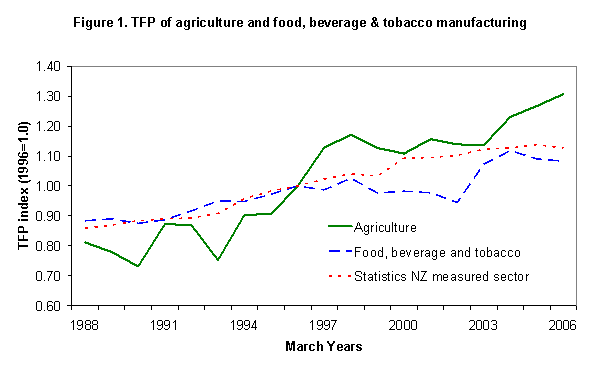
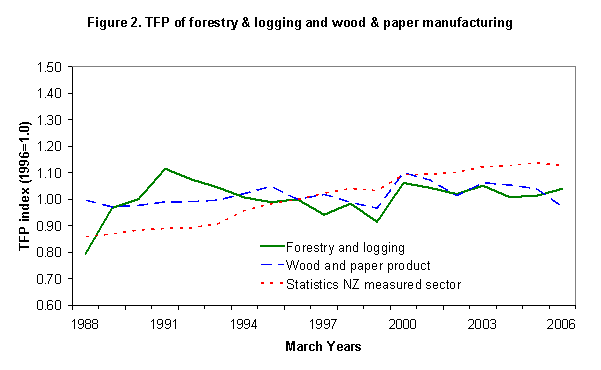
The following sections discuss the results for each sector.
Agriculture
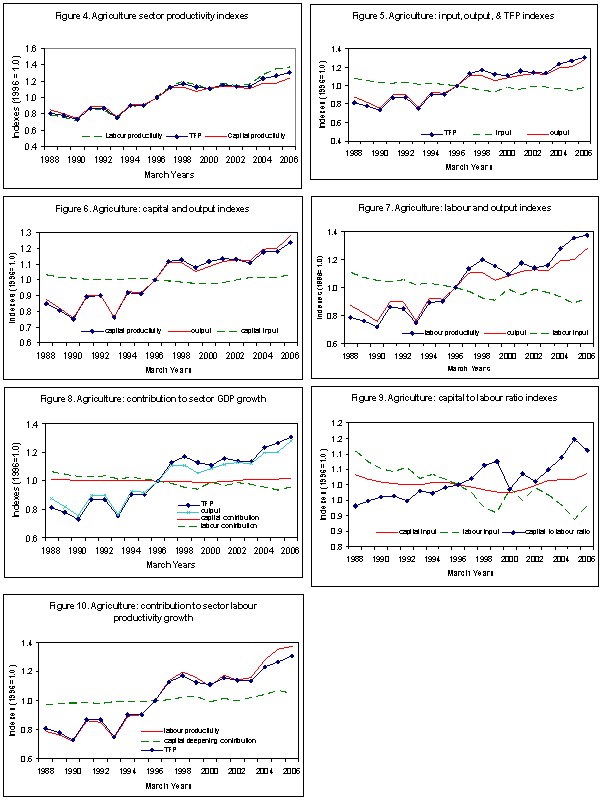
The average TFP growth rate for agriculture during 1988-2006 was 2.7 percent per year[9]. Labour productivity and capital productivity had similar trends from 1988 to 2002. Since 2003, labour productivity has grown faster than capital productivity (5.8 vs. 3.8 percent per year) (Figure 4 Appendix), which made up 3.1 percent annual growth for labour productivity and 2.1 percent annual growth for capital productivity.
The fluctuation in TFP growth could be further explained by the movements of output and input growth. Over the whole period, output (GDP) grew by 2.1 percent per year while input decreased by 0.5 percent per year. Output growth fell in 1990 and 1993 and was mostly affected by drier weather conditions in those years (MAF, 1990 and 1994). The 2000 dip reflects the flow-on impacts from the Asian financial crisis and also El Nino and subsequent La Nina droughts which happened around this time (MAF, 2000 and 2001).
Total factor input has been falling since 1988 and the decline only slowed since 2000. Before 2000, input decreased at 0.8 percent per year. After that, input stayed roughly the same. The decrease in input before 2000 was made up of a 0.5 percent per year decrease in capital and a 1.0 percent per year decrease in labour. After 2000, capital increased at 1.0 percent per year while labour kept decreasing at the same rate (Figure 9 Appendix).
Decomposition of agricultural output growth into TFP and factor input growth showed a significant contribution from TFP growth during 1988-2006. In fact, TFP growth has been higher than output growth (at 2.1 percent per year), which helped to offset the decline in labour contribution.
Compared to Statistics New Zealand’s TFP estimate for the measured sector using a similar database for the same period (1.5 percent per year), agricultural annual TFP growth was 1.8 times higher. Our results are comparable to estimates by other authors. For example, Diewert and Lawrence (1999) showed an annual agricultural TFP growth rate of 3.6 percent for 1986-1998, our results showed an annual growth rate of 3.7 percent for 1988-1998. Hall and Scobie (2006) showed an annual growth rate of 2.6 percent for 1984-2001, which is similar to our results for 1988-2001.
New Zealand’s agricultural TFP growth is comparable to those of the US and Australia and much higher than that of the UK for similar periods of time. For example, Fuglie et al (2007) showed 2.4 percent annual TFP growth for US agriculture for 1988-2004 (our result showed 2.2 percent annual growth for New Zealand during this period). Mullen (2007) quoted results from ABARE (2006) showing 2.2 percent annual TFP growth for broadacre Australian agriculture for 1989-2004. Thirtle and Holding (2003) showed only 0.5 percent annual TFP growth for UK agricultural TFP for 1988-2000.
Productivity growth is often compared to the terms of trade as both can be used as indicators for competitiveness. Increased sector productivity lowers real output prices and thus improves its international competitiveness (Mullen et al, 2006). The commodity terms of trade for a country is measured as the price of the country’s exports divided by the price of its imports. For the primary sector, the conventional case is a declining terms of trade over time due to real commodity prices declining compared to other goods.
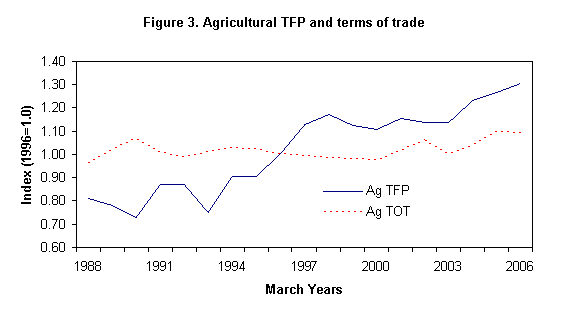
Source: MAF and Statistics New Zealand
Note: Agricultural terms of trade is calculated a ratio of pastoral export price index to total merchandise import price index.
Figure 3 shows agricultural TFP and terms of trade trends for the period 1988-2006. The sector terms of trade was static over the 1990s period, but has picked up since 2000. Terms of trade growth was 1.9 percent per year for the period 2000-2006 compared to only 0.7 percent per year for the whole period. The fact that TFP also followed an increasing trend since early 2000s shows a positive story for the sector’s competitiveness.
Previous research[10] often showed a significant contribution from research and development (R&D) to sector productivity growth. Hall and Scobie (2007), for example, showed an annual rate of return of 17 percent from investment in domestic R&D. Mullen et al (2006) took this further by estimating that approximately 77 percent of New Zealand agricultural productivity growth was derived from private and public research, extension, and foreign knowledge spillovers, leaving 23 percent contributed from public infrastructure and education. These estimates excluded other potential impacts on productivity growth such as weather conditions and policy reforms.
Forestry and logging
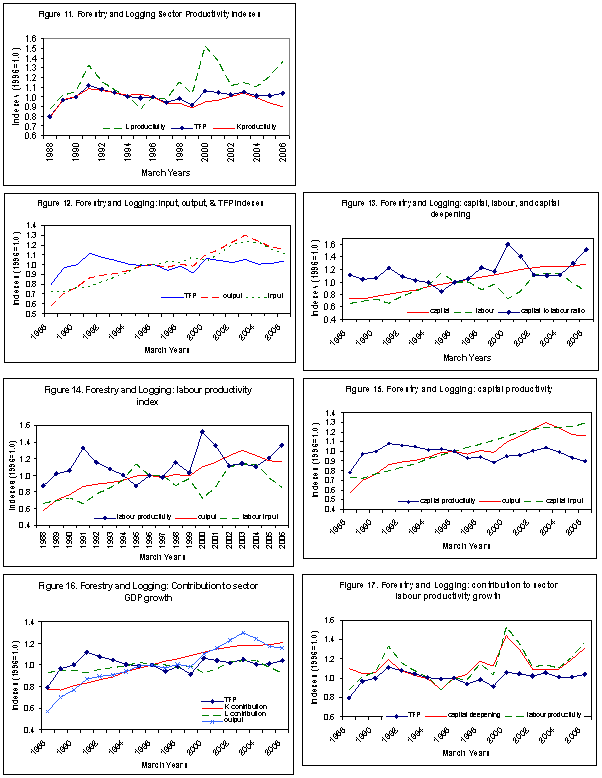
Annual average TFP growth of forestry and logging was estimated at 1.5 percent for the period 1988-2006. Average capital productivity growth during this period was 0.8 percent per year. Labour productivity growth was quite volatile with an annual average growth rate of 2.5 percent (Figure 11).
Over the 1988-2006 period, forestry inputs and output have followed similar trends with output growing by 4 percent per year and total input growing at 2.4 percent per year. During the 1990s, input growth exceeded output growth (4.2 vs 1.6 percent per year), resulting in declining TFP until 2000. The slowdown of TFP growth at the end of 1990s also reflected the impact of the Asian financial crisis around this time (MAF, 1999).
Labour input has been volatile during the study period (Figure 13). The reduction in employment numbers in 1991 and 1999 have lead to labour productivity spikes in these year. These were associated with the New Zealand government’s decision to sell large forestry areas to the private sector.
Capital input has been on the rise since 1988. Annual average growth was 3.2 percent, in contrast to only 1.4 percent annual labour growth. This also reflected the increase in standing timber stocks by almost 200 percent from 1988 to 2006.
Decomposition of output growth showed a significant contribution from capital growth (2.5 percent per year). TFP growth contributed 1.5 percent per year while there is almost no contribution from labour growth.
Generally, forestry and logging had a lower TFP growth rate compared to agriculture but was on par with the economy average. Compared to other significant players on the international market, New Zealand’s TFP growth rate at 2.4 percent for the period 1989-2000 was substantially higher than Canada’s TFP growth rate of 0.35 percent (Centre for the Study of Living Standards (CSLS), 2003).
Food beverage and tobacco manufacturing
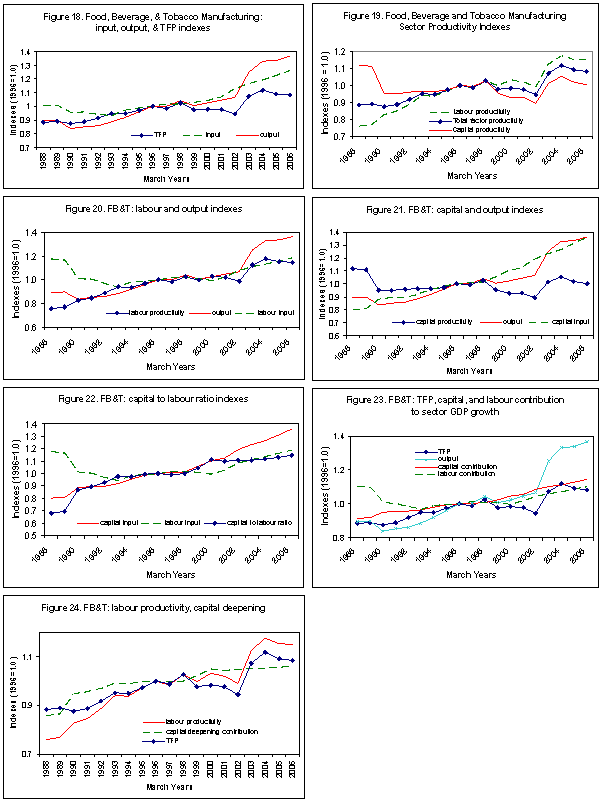
Annual average TFP growth of the food, beverage, and tobacco manufacturing sector was 1.1 percent during the 1988-2006 period. Labour productivity grew strongly at 2.3 percent per year while capital productivity declined 0.6 percent per year (Figure 19).
Overall, output grew strongly at 2.4 percent per year. Total factor input grew at 1.2 percent per year for the whole period and only picked up after 1998 at 2.7 percent per year (Figure 18).
Capital input has been on the rise since the beginning of the study period, averaging 3 percent per year. Labour input only started to grow after 2000 at 3 percent per year. This balanced out the decline in the 1988-2000 period, leading to no growth of labour input during the study period (Figure 20).
Decomposition of output growth showed significant contribution from both TFP and capital growth (1.1 and 1.3 percent per year). Similar to other sectors, there was no contribution from labour input.
Total factor productivity growth in food, beverage, and tobacco manufacturing was lower than those of the primary sectors and the national average. This is similar to results found by Diewert and Lawrence (1999) who estimated a growth rate of 0.5 percent per year for the sector from 1986 to1998.
Wood and paper product manufacturing
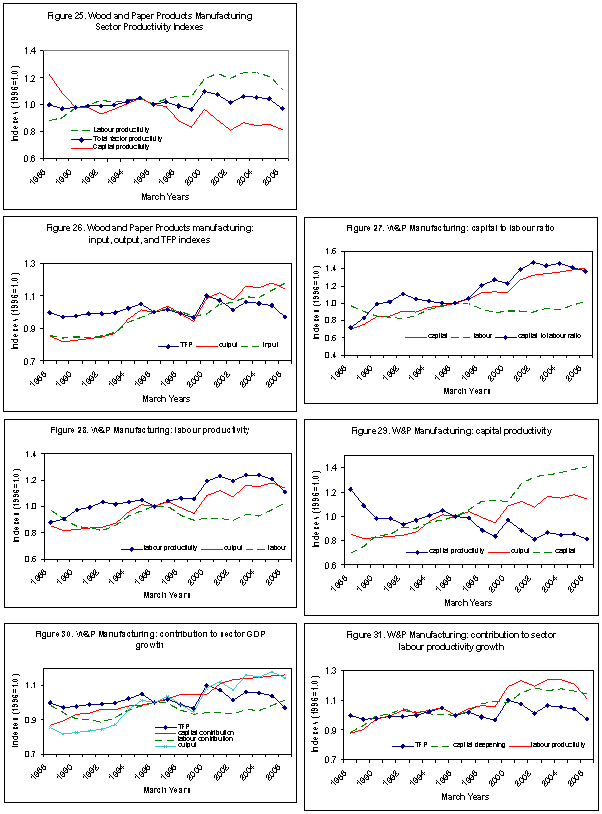
There was no TFP growth for this sector during the 1988-2006 period. However, labour productivity grew at 1.3 percent per year. Capital productivity declined at 2.2 percent per year.
Output has been growing at 1.6 percent per year during the study period; however input has been growing at a slightly higher rate of 1.8 percent per year. Growth in inputs was made up of 4 percent annual growth in capital and 0.3 percent annual growth in labour. In fact, capital has been growing strongly since the beginning of the period, while labour only picked up in recent years.
Decomposition of output growth showed a significant contribution from capital growth (1.6 percent per year). There was no contribution from TFP and only a small contribution from labour growth.
TFP growth in wood and paper processing is lower than other sectors and the economy average. The dynamics, however, may be different between wood and paper processing. According to Maplesden and Turner (2006), the low rate of productivity growth in the New Zealand forestry processing sector has a number of causes. For example, New Zealand’s timber processing facilities are small by international standards and often employ older or second hand mill equipments. This is reflected in the increasing capital input but the productivity achieved is not great.
Diewert and Lawrence (1999) also showed no TFP growth for wood manufacturing during the 1986-98 period. Paper processing’s TFP growth was found to be 1.1 percent per year for the same period.
Comparing internationally, New Zealand wood and paper processing TFP growth is clearly lower than that of Canada and Finland during a similar period (1989-2000), but relatively higher than that of the US (being 1.5, 5.1, and -0.4 percent per year respectively) (CSLS, 2003).
Conclusion
This paper reports the Ministry of Agriculture and Forestry’s (MAF’s) recent and ongoing research in measuring TFP growth in the primary and downstream manufacturing sectors. The results showed 2.7 percent annual TFP growth in the agriculture sector during the period 1988 to 2006. Forestry and logging’s TFP grew at a lower rate (1.5 percent) which is similar to that of the economy’s average. Both downstream manufacturing sectors’ TFP grew at lower rates than the primary sectors and the economy average (being 1.1 and -0.1 percent respectively). For all sectors, the results are the aggregate average growth as we have not, as yet, been able to measure TFP for the sub-sector levels.
This paper therefore serves the purpose of reporting our measurement results using recently published Statistics New Zealand data. Further research into the drivers behind TFP growth for the sectors is underway. The next phase of MAF’s research is to measure TFP at the sub-sector levels. This will lead to a better understanding of the drivers of TFP and the role of resource reallocation in the sectors.
References
Black M., Melody G., and McLellan N. (2003), Productivity in New Zealand 1988 to 2002, Treasury working paper 03/6.
Coelli T.J., Rao D.S.P., O’Donnell C.J. and Battese G.E. (2005), An Introduction to Efficiency and Productivity Analysis, 2nd Edition. Springer, New York.
Centre for the Study of Living Standards (CSLS), 2003, An analysis of productivity trends in the forest products sector in Canada, Ontario, Canada,
Diewert and Lawrence (1999) Diewert E. and Lawrence D. (1999), Measuring New Zealand's productivity, Treasury working paper, http://www.treasury.govt.nz/workingpapers/1999/99-5.asp
Forbes R.and Johnson R. (2001), Recent Trends in Agricultural Productivity, Agribusiness Review, Vol. 9, 2001. http://www.agrifood.info/review/2001/Forbes.html
Fuglie, O., MacDonald, J., and Ball, E. (2007), Productivity growth in US agriculture, EB-9, USDA, ERS.
Hall J. and Scobie G. (2006), The role of R&D in productivity growth: the case of agriculture in New Zealand: 1926-27 to 2000-01, Treasury working paper 06/01.
Johnson R. (1996), Agricultural Productivity trends for New Zealand 1972-1992, MAF Policy Technical Paper 96/2, Wellington, New Zealand
Johnson R. and Forbes R. (2000), Recent Productivity Trends in New Zealand Primary Sectors, MAF Technical Paper no. 2000/20.
Lattimore R. (2006), Farm subsidy reform dividends, Paper presented at the North American Agrifood Market Integration Consortium Meeting, Calgary, Alberta, 1-2 June.
MAF (1990), Situation and Outlook for New Zealand Agriculture (SONZA), Wellington, New Zealand.
MAF (1994), Situation and Outlook for New Zealand Agriculture (SONZA), Wellington, New Zealand.
MAF (1999), Situation and Outlook for New Zealand Agriculture and Forestry (SONZAF), Wellington, New Zealand.
MAF (2000), Situation and Outlook for New Zealand Agriculture and Forestry (SONZAF), Wellington, New Zealand.
MAF (2001), Situation and Outlook for New Zealand Agriculture and Forestry (SONZAF), Wellington, New Zealand.
Maplesden, F. and Turner, J. (2006), New Zealand Forest Industry Position and Opportunities, A report prepared for the Forest Industry Development Agenda Steering Committee.
Mawson P., Carlaw K. I., and MacLellan N. (2003), Productivity measurement: Alternative approaches and estimates, Treasury working paper 03/12.
McLellan N. (2004), New Zealand's Performance: Context and Challenges, Treasury workshop on Productivity: Performance, Prospects and Policies.
Mullen, J., Scobie, G., and Crean, J.(2006), Trends in research, productivity growth and competitiveness in agriculture in New Zealand and Australia, invited paper presented to the 2006 NZARES conference, Nelson, New Zealand.
Mullen, J. (2007), Productivity growth and the return from public investment in R&D in Australian broadacre agriculture, Presidential address to the 51st Annual conference of AARES, Queenstown, New Zealand.
OECD (2001), OECD productivity manual: a guide to measurement of industry-level and aggregate productivity growth, Paris.
Philpott, B.P. and Stewart, J.D. (1958), Capital, income and output in New Zealand agriculture 1922-1956, Economic Record, Vol 44.
Statistics New Zealand (2006), Productivity Statistics 1988-2005, Hot Off the Press, http://www.stats.govt.nz/products-and-services/info-releases/productivity-statistics.htm
Thirtle, C. and Holding, J. (2003), Productivity of UK agriculture causes and constraints, Final report on Project No. ER0001/3, DEFRA, available at http://statistics.defra.gov.uk/esg/reports/prodagri/default.asp
USDA (1980), Measurement of US Agricultural Productivity, Technical Bulletin no. 1614, Washington, USA
Appendix